Understanding the genetic diagnosis behind Angelman syndrome
A test name matters. 'Genetic testing was normal' does not tell you whether methylation, copy-number changes, UBE3A sequence variants, UPD, or imprinting mechanisms were evaluated.
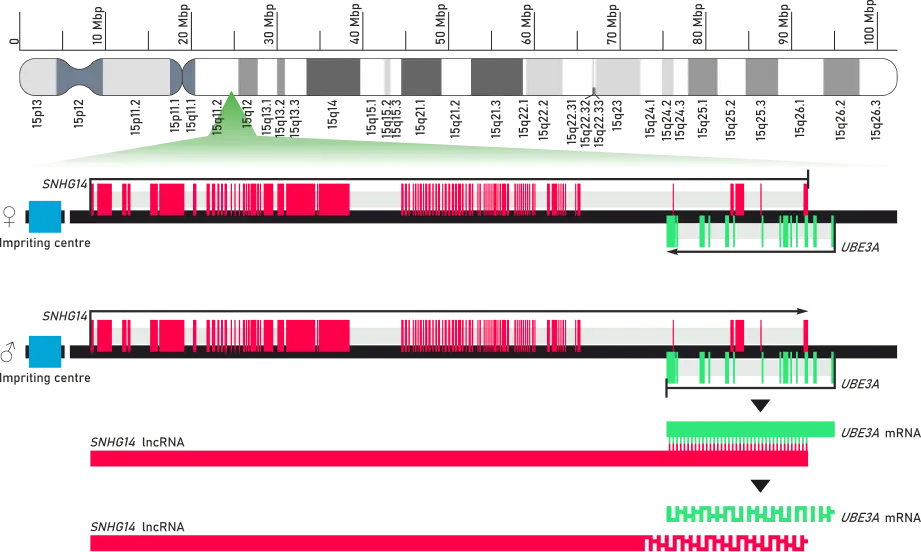
Why one test may not answer every question
Different methods answer different questions. A normal result from one test does not rule out every Angelman mechanism. The report should state exactly which methods were used and which mechanisms were assessed.
Diagnostic pathway overview
Main molecular mechanisms
15q11.2–q13 deletion
A missing segment on the maternal copy of chromosome 15 that includes UBE3A.
UBE3A pathogenic variant
A sequence change within the UBE3A gene that reduces or removes function.
Paternal uniparental disomy (UPD)
Both copies of chromosome 15 are inherited from the father.
Imprinting defect
The maternal UBE3A gene is present but not properly activated.
What common methods detect
| Method | Main question | Mechanisms commonly detected | Important limitations | Does it define the exact mechanism? |
|---|---|---|---|---|
| DNA methylation analysis | Is the maternal UBE3A region methylated/active? | Detects most deletions, UPD, and imprinting defects | May miss some UBE3A point variants; does not identify the exact mechanism in all cases | No — usually needs follow-up testing |
| MS-MLPA | Are copy-number and methylation patterns abnormal? | Deletions, some imprinting defects | May not detect all sequence variants or UPD without additional analysis | Can define deletion and some imprinting findings |
| Chromosomal microarray | Are there copy-number changes in the 15q region? | Large deletions and duplications | Does not detect methylation, UPD, or small sequence variants | Defines deletion size but not mechanism alone |
| FISH | Is a specific 15q region deleted? | Large deletions | Low resolution; does not detect methylation, UPD, or sequence variants | No — limited resolution |
| UBE3A sequencing | Are there sequence variants in UBE3A? | UBE3A pathogenic variants | May miss large intragenic deletions/duplications or methylation defects | Yes, when a pathogenic variant is identified |
| UBE3A deletion/duplication analysis | Are there intragenic copy-number changes? | UBE3A exon-level deletions or duplications | Does not detect point variants or methylation defects | Yes, when confirmed |
| UPD analysis | Are both chromosome 15 copies from one parent? | Paternal UPD | Does not detect deletions or sequence variants | Yes, when confirmed |
| Exome/genome sequencing | Are there variants in UBE3A or other genes? | UBE3A variants and Angelman-like differential diagnoses | May not detect methylation or imprinting defects; interpretation can be uncertain | Sometimes; depends on the finding |
Not sure what your previous tests covered?
A genetic report review can map the methods used, the mechanisms assessed, and the questions that still need answers.
You can begin with a document review. You do not need to commit to a research project.